Costs
Part of Primary market research: the version that survives contact with reality
Primary market research checklist, from first line to sign-off
A primary market research checklist that ties sampling frame, instrument pilot, consent records, quota cells and reporting limits to one decision.
What to take away
- Write the decision and the evidence threshold before the questionnaire, so a result that changes nothing is visible on day one.
- Define the population frame and the recruitment source in the same document; a sample you cannot describe is a sample you cannot defend.
- Pilot the invitation, the consent screen and the last question as one path, then freeze a version number.
- Keep consent records, raw files and the coding scheme together, because a report without them is an assertion.
- Put export rights, deletion dates and exit costs in the supplier contract before fieldwork starts.
Start from the decision, not the questionnaire
A primary market research study earns its cost when a named person will act differently depending on the answer. Write that decision down, with the owner and the date it must be made.
Then write the threshold. If the study shows X, we do this; if it shows Y, we do that. A study with no threshold becomes a deck nobody cites.
Check what you already own before buying new data. Internal records, prior studies and public sources often answer the cheap half of the question. Knowing what primary market research asks, and why helps you separate the questions only new fieldwork can settle from those a desk review can close.
Population frame and sampling
The frame is the list you actually draw from: a customer file, a panel, a purchased sample, a recruitment drive. Say which one, and say who it leaves out.
Write inclusion and exclusion criteria, the subgroups you must report separately, and the smallest subgroup worth reporting. A subgroup of nine people is a story, not a finding.
Sample size follows from the decision, not from habit. For a proportion, the standard error is sqrt(p(1-p)/n); substitute your own p and n to see what precision you are buying. Quotas, weighting and response rates belong in the same note.
Instrument design
Ask one thing per question. Use a recall period the respondent can actually hold, such as the last seven days, not "typically."
Balance the options. A scale that runs from very satisfied to extremely satisfied measures enthusiasm, not satisfaction.
Test translations with the people who will read them. A question that survives translation into Spanish may still fail in a bilingual household where the survey arrives in the wrong language.
Pilot the whole path: invitation, consent screen, first question, last question, thank-you page. Time it. Then freeze a version number and log every change after that.
Consent, PII and participant care
The joint HHS and FDA electronic informed consent guidance describes consent screens that support understanding, navigation, questions, time to decide and continuing contact. Its regulatory scope covers covered research, not ordinary market studies. Borrow the usability tests, and route your own consent language through qualified counsel.
NIST Special Publication 800-122 is a 2010 federal guide to identifying personally identifiable information, rating confidentiality impact and planning incident response. It is a prompt, not a privacy program. Pair it with current law and your own data map.
- Keep direct identifiers in a separate file from responses, joined by a study ID.
- State the retention period and the deletion date in the consent screen, not in a policy page.
- Honor withdrawal by deleting the record, and say so plainly.
- Keep research separate from sales follow-up and list building.
Fieldwork quality checks
Predefine the checks before the first interview, so nobody invents them after seeing a bad week.
| Signal | What to pull | What it usually means |
|---|---|---|
| Straight-lining | Response grid by respondent | Fatigue or a bad scale |
| Speeders | Median completion time | Bots or a rushed panel |
| Open-end blanks | Item nonresponse by question | Ambiguous wording |
| Duplicate IPs | Device and session logs | Panel fraud |
Investigate two signals together before excluding anyone. Preserve the original file, and log every exclusion with a reason.
Analysis and reporting
Predefine units, coding rules, outcomes and how you will treat missing data. Coding open answers collapses under volume fast; decide the code frame and the sample of answers you will read before the field closes.
Separate what participants said from what you estimate from what you recommend. Readers can follow a report that keeps those apart.
Report the population, the sample source, the field dates, the method and the denominators. Name the groups you cannot generalize to.
Supplier and contract terms
For agencies, panels and tools, settle these in writing. Name the team and subcontractors. Define participant treatment and data locations. Clarify ownership and export format. Set the incident notice window. Address correction and deletion rights. Address exit cost.
Ask how artificial intelligence is used on the data, and whether responses train anything. Get the answer in the contract, not in a call.
The W3C Privacy Principles statement warns against pushing privacy work onto individuals. Apply that to your notice and consent design, then check the governing law with counsel.
The CISA software acquisition fact sheet covers supply-chain exposure and vulnerability management. Those questions belong in a tool review, not in a local approval.
Common questions
Does a completed checklist prove the research is valid?
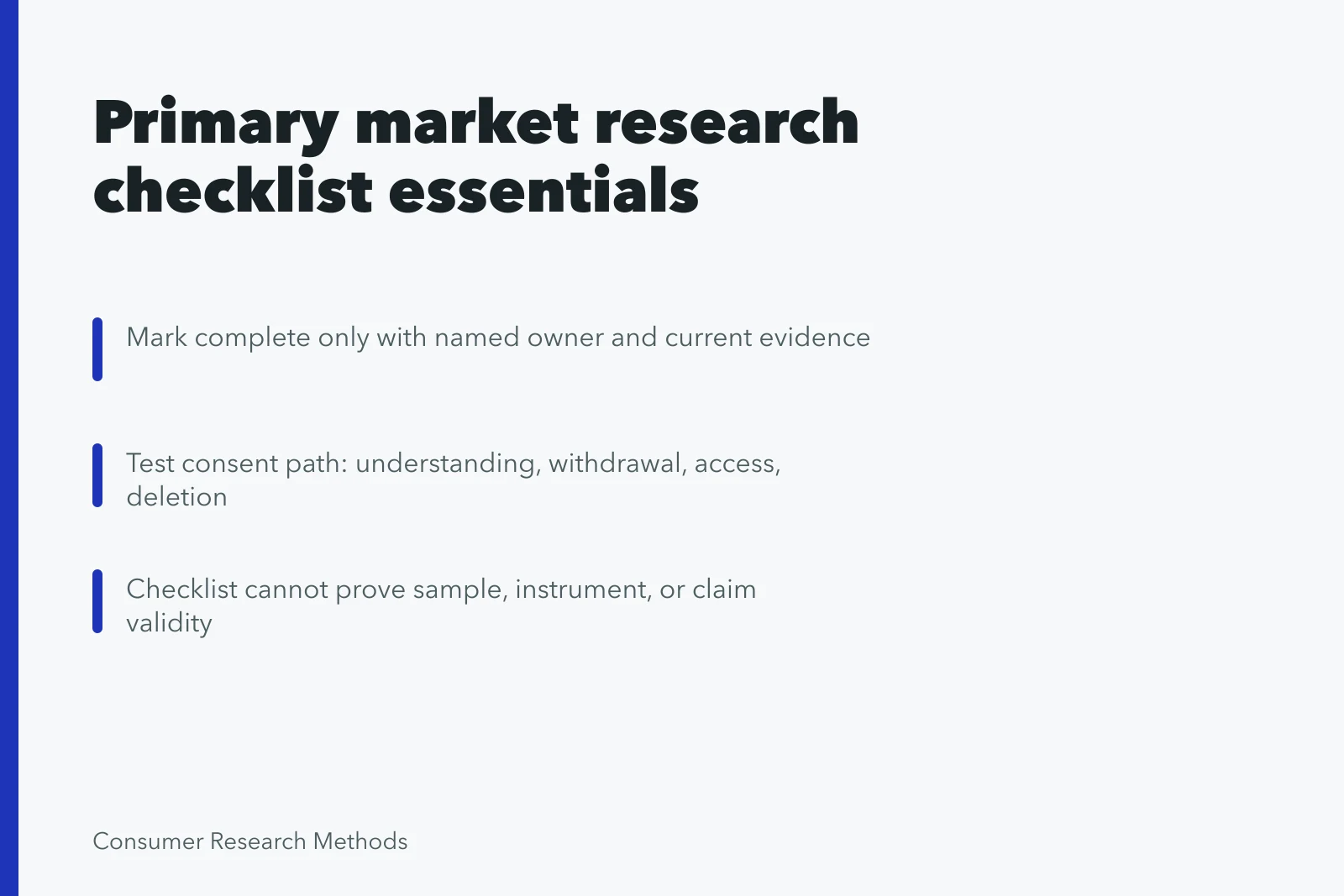
No. It creates reviewable gates and a record. Qualified people still judge whether the method fits the question and whether the evidence supports the claim.
Who should own the checklist?
Split it. The decision owner signs the threshold, the research lead signs the frame and instrument, and privacy or security signs the data handling. One person signs final approval.
When should the checklist be repeated?
Changes requiring notification:
- After any material change to the purpose
- population
- method
- instrument
- supplier
- system
- or intended use. A new claim on old data is a material change.
What belongs in the evidence register?
The charter, the approved instrument version, the consent record, the data flow, the retention date and the exclusion log. If a gate cannot show one of those, it is not closed.
Teams that want a fuller walkthrough of how to research primary market research for business teams should treat this register as the backbone.
Anyone weighing whether existing sources already answer the question should read secondary market research: a practical guide before commissioning new fieldwork.