Careers
Part of Making sense of market research strategy (2027 update)
Market research strategy trends worth taking seriously
Inclusion, digital access, transparency and observability are the research trends that change how small teams scope, field and defend a study.
What to take away
- Inclusion is a recruitment and materials problem before it is an analysis problem: who you can reach, in what language, on what device.
- Transparency is a deliverable, not a closing note. Methods, exclusions and uncertainty belong in the plan and the contract.
- Observability means someone watches recruitment source, quotas, duplicates and dropout while fieldwork is live, with authority to pause.
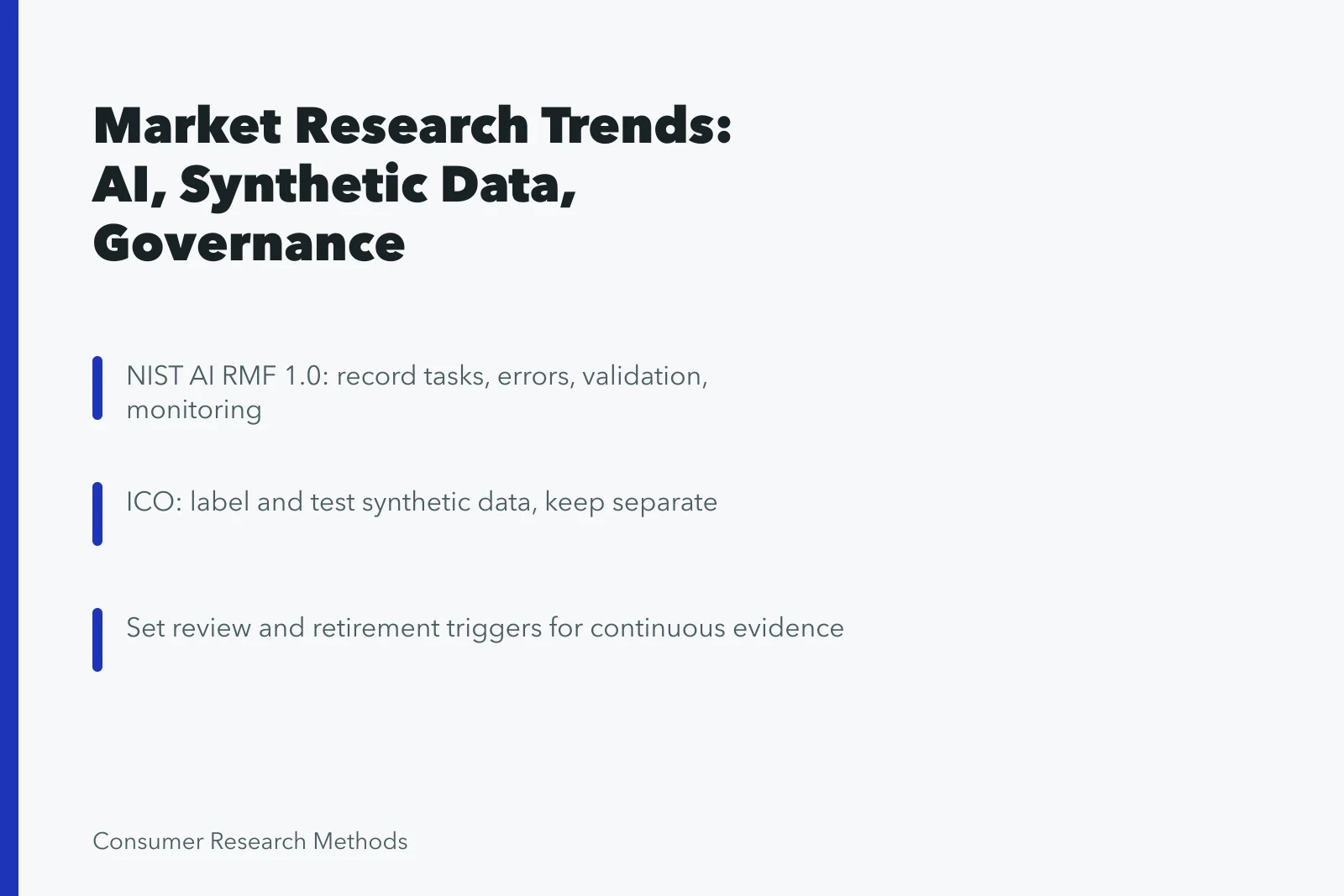
- Synthetic data and AI-assisted coding stay labeled and separate from claims about real people.
- Every trend gets a review date and a retirement trigger, or it becomes permanent overhead.
What inclusion actually costs
Recruitment that reaches disabled people, people with limited digital access, low literacy, another first language, or a rural location is a scoping decision made before the screener is written. Each added condition narrows the pool and lengthens field time.
Inclusion Cost Arithmetic
- 8interviews with screen-reader users
- 2markets
- 40general-population completes
- Target completes x incidence x cost per recruit
Practical levers: screeners in the participant's language, not translated after; phone and in-person options alongside online; screen-reader-compatible survey platforms; incentives that do not require a bank account. A market research strategy checklist keeps populations and modes visible in one place.
Budget the trade honestly. A quota of eight interviews with screen-reader users in two markets may cost more per complete than forty general-population completes. Give the reader the arithmetic in their own numbers: target completes times incidence times cost per recruit, plus the accessibility work.
Transparency as a deliverable
Decision makers increasingly ask what was asked, of whom, in what mode, and what was left out. Build that into the statement of work. Name the population, the exclusions, the question wording, the incentive, the field dates and the funding source.
Transparency Deliverable Checklist
- Name the population
- List exclusions
- Record question wording
- State incentive
- Give field dates
- Disclose funding source
- Note AI assistance
- Publish uncertainty limits
Where AI assisted transcription, translation or coding, say so in the methods note. This is disclosure about the study, not about the page you are reading.
Uncertainty belongs in the same document. A margin of error, a small base, or a quota cell of six all change what a number can support. Publishing the limit is cheaper than defending the claim later.
Observability: what to watch while fieldwork runs
Continuous evidence systems, standing panels and always-on listening shorten learning cycles and create new failure modes: stale consent, repeated contact, panel conditioning, context loss.
A monitoring list a small team can actually run:
Observability: what to watch
| Watch item | Trigger | Owner action |
|---|---|---|
| Recruitment source mix | One source above 60% of completes | Pause that source, check frame |
| Duplicate or straight-line responses | Above your pilot baseline | Pull records, re-verify |
| Quota drift | Cell off target at midpoint | Adjust incentive or mode |
| Dropout point | Same question across sessions | Review wording and length |
| Consent age | Older than your stated window | Re-consent or retire |
| Analysis version | Any change after topline | Re-issue with version note |
Each alert needs a named owner, pause authority, and a written response path. Without them, monitoring produces dashboards nobody acts on.
Synthetic data and AI assistance, kept in their lane
The U.K. Information Commissioner's Office describes synthetic data as artificial data generated to reproduce patterns and statistical properties of real data, and discusses privacy risk and whether outputs are anonymous. Its legal scope is specific to that regime; confirm your own obligations with qualified counsel.
Generated responses can test an instrument or stress an assumption. They do not become customer evidence because they read like speech. Teams that blur the two should review the market research strategy mistakes that follow from that assumption.
For AI used anywhere in the workflow, the NIST AI Risk Management Framework 1.0 gives a voluntary, use-case-agnostic structure across design, development, deployment and evaluation. Applying it here is an inference, not certification. Record the task, the data, observed errors, human review, monitoring and stop conditions.
Where secondary data fits
Inclusion and observability both push teams toward cheaper context. Official sources carry the population detail a small sample cannot: the U.S. Census Bureau for demographics and geography, the Bureau of Labor Statistics for employment and spending. Use secondary market research to set quotas and sanity-check incidence before you buy sample.
The W3C Privacy Principles give designers shared privacy concepts and warn against shifting privacy work onto individuals. That warning applies to consent language and to how much you ask of a participant who is already giving you an hour.
A dated watchlist
The NIST AI RMF Playbook lists voluntary actions under govern, map, measure and manage. It is a reference, not a forecast or a product ranking.
Give every signal on your list a review date and a retirement trigger. A trend that has not changed a decision in two cycles is overhead. Review the whole set against your market research strategy once a year.
Common questions
Does inclusive recruitment mean a bigger sample?
Not necessarily. It usually means a different mix of modes and languages, and a longer field window. Cost per complete rises before total cost does, and the arithmetic is target completes times incidence times cost per recruit.
Is transparency a legal requirement?
Some disclosures are set by law in specific jurisdictions, and those vary. Treat the methods note as a professional deliverable regardless, and check the applicable rules with qualified counsel.
Can synthetic data stand in for hard-to-reach groups?
It can test whether an instrument works before you spend on recruitment. It cannot tell you what those participants experience, and it should never carry a prevalence claim.
Who owns the monitoring list?
Name one person per alert, not one person for the dashboard. That owner needs authority to pause recruitment without waiting for a meeting.