Costs
Part of Making sense of market research strategy (2027 update)
What the market research strategy best practices look like in practice
A market research strategy works when every study answers a named decision, and when the evidence trail survives review by someone who was not there.
What to take away
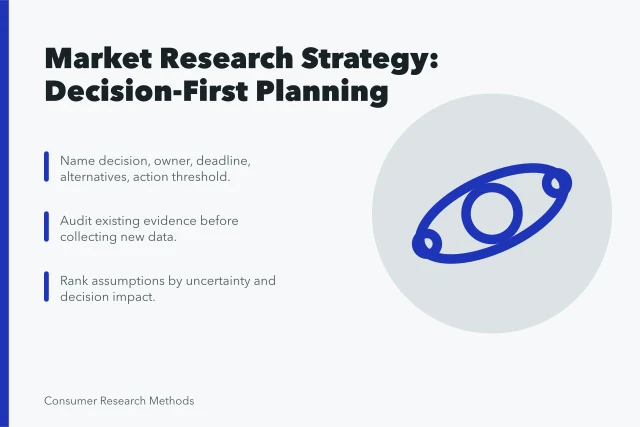
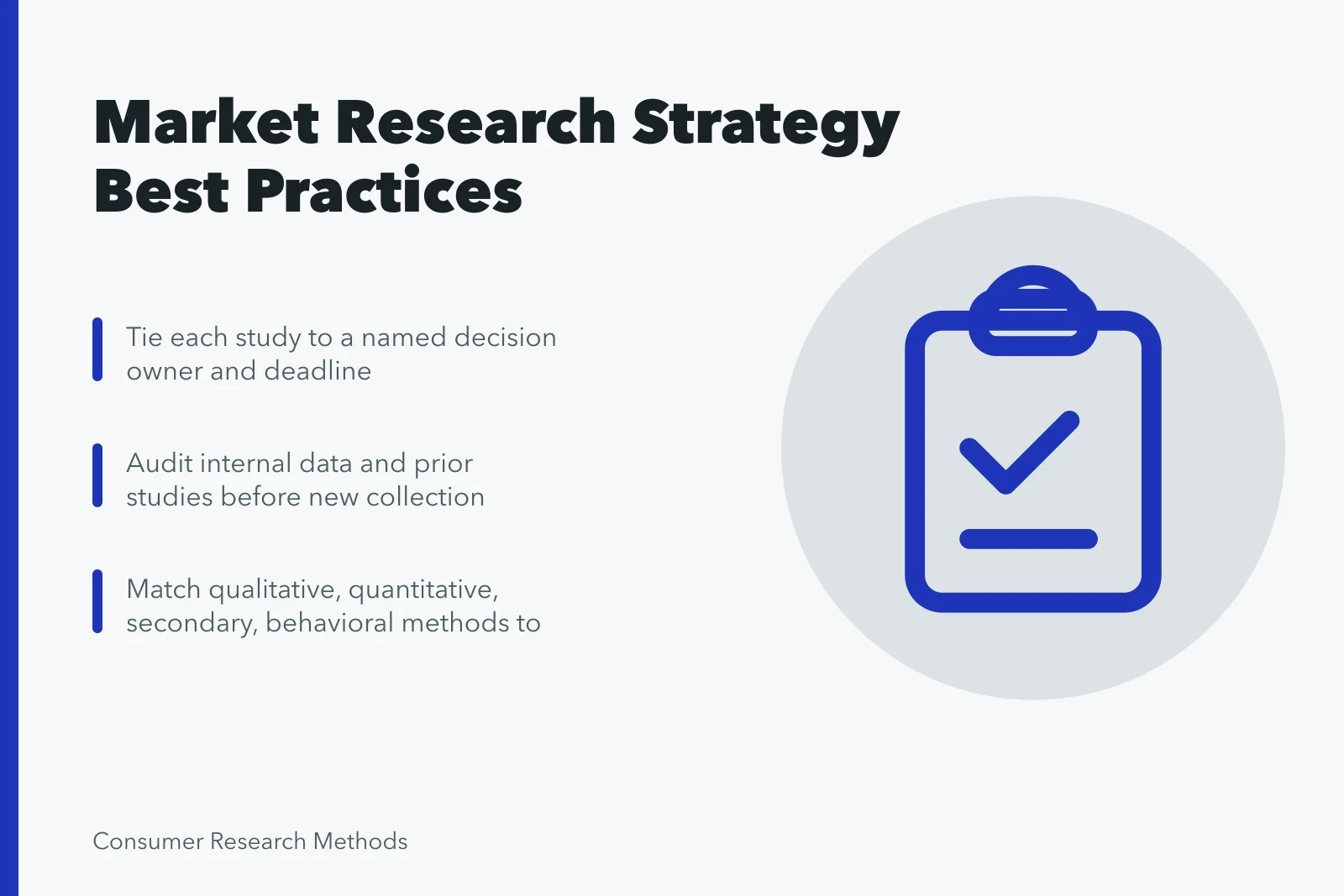
- Write a one-page charter before fieldworkthe decision, its owner, the deadline, the alternatives being weighed, and the evidence threshold that settles the choice.
- Audit internal data, prior studies, Census and BLS series, and lawful competitor material before you pay for new collection.
- Keep observations, interpretations, and management choices in separate layers so a reviewer can follow any finding back to its source.
- Pilot the whole path, not the questionnaire alonerecruitment, screener, consent, incentives, exports, and analysis.
- Report inconclusive results as findings. A study that stops a bad launch has paid for itself.
Market research strategy best practices are mostly bookkeeping. They force a team to write down what it will do with an answer before it spends money asking.
Start with the decision, not the method
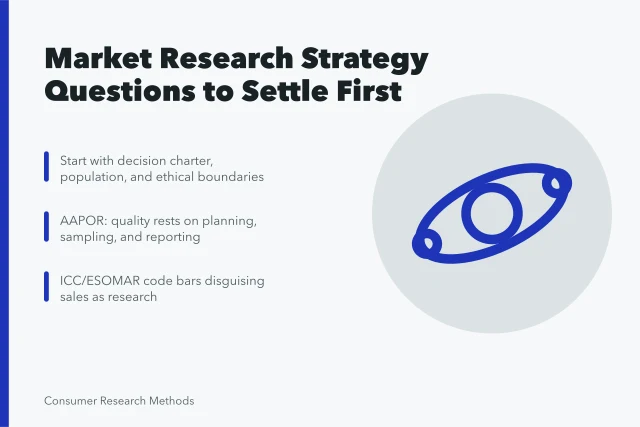
A charter fits on one page. It names the decision, the person who owns it, the date it must be made, the options on the table, and the evidence threshold that would settle the matter.
One-Page Research Charter
- Named decision
- Decision owner
- Decision date
- Options on the table
- Evidence threshold
If no decision depends on the answer, the study is decoration. Kill it there, before recruitment costs money.
Define the market on one boundary
Write down the problem, the buyer, the category, and the substitutes. Also write down the geography and the period the numbers cover. Census Bureau and BLS series are free and already defined; check whether their boundary matches yours before you cite them.
Every estimate in the report should sit on the same boundary. Mixing a metro figure with a national one is the most common silent error in small-team research.
Reuse before you collect
Audit internal data, prior studies, official statistics, and lawful competitor evidence first. For each source, check several details. These include the population, the definition, the collection date, and the method. Also check your right to reuse it.
A market research strategy checklist is useful here because reuse decisions are easy to skip under deadline pressure.
Match the method to the question
Use interviews and focus groups for context and mechanism. Use surveys for estimation you can put a number on. Use secondary sources for structure that already exists.
Behavioral evidence answers causal questions better than stated preference. Do not force every question into one instrument.
Pilot the full path
Test recruitment, the screener, consent language, and the questions before full fieldwork. Also test the incentives, the recording, the export, and the analysis. Fix the approved version, then log every later deviation.
Screeners that over-filter produce a clean sample of the wrong people. Pilot the screener against your incidence assumption.
Make the analysis traceable
GOV.UK's research analysis guidance sets out a sequence for public-service teams: separate observations from interpretations, group the material, form findings, decide actions, share results. The timing it suggests suits that context, not every study.
Preserve the chain from source observation to analytic step to finding to business action. Predefine coding, exclusions, weighting, and thresholds before you look at the data.
Disclose enough to be checked
AAPOR's Transparency Initiative asks covered research to disclose several things:
- sponsorship
- instruments
- population
- sample generation
- recruitment
- modes
- field dates
- counts
- weighting
- limitations
Disclosure does not prove quality. It lets an outside reviewer judge the evidence and reproduce the important decisions.
Close the loop
Record the decision, the action, the owner, the outcome measure, and the date you will revisit it. Retire evidence that no longer fits the market.
Negative and mixed findings are results. Protect the researcher from pressure to reach a preferred conclusion.
Best-practice evidence map
Evidence
- Decision first
- Charter and threshold
- Traceable analysis
- Source-to-finding record
- Transparent limits
- Methods and uncertainty
- Closed loop
- Decision and follow-up
Failure response
- Decision first
- Stop decorative research
- Traceable analysis
- Correct unsupported claim
- Transparent limits
- Narrow interpretation
- Closed loop
- Assign action owner
Assign the practice
The NIST Privacy Framework starting guide describes a voluntary process for identifying and managing privacy risk. Use it to name data and response owners. It is not legal clearance.
The CISA business-system logging guidance explains how event records support security review. Keep access, change, and correction records for research data without claiming that logging validates a metric.
Common questions
Should raw observations be edited?
Preserve authorized source evidence as collected. Build a separate interpreted layer with documented coding, exclusions, versions, and corrections, so a reviewer can see exactly where judgment entered.
What should every report disclose?
Here is the information:
- Sponsor
- Purpose
- Population
- Sources
- Methods
- Recruitment
- Field dates
- Counts
- Instruments
- Processing
- Analysis
- Uncertainty
- Limitations
- Conflicts AAPOR's Transparency Initiative lists the full set for covered research.
Can best practices remove uncertainty?
No. They reduce avoidable error and make the remaining uncertainty visible, so the decision owner can judge whether the evidence is sufficient to act.
What if the study is inconclusive?
Say so, and say what would have changed the answer. An inconclusive result that stops an unjustified launch is a successful study, not a failed one.