Strategy
Part of Making sense of market research strategy (2027 update)
Reading market research strategy benchmarks without fooling yourself
Federal survey standards and the U.K. statistics code give small research teams a defensible way to set market research benchmarks and check them.
What to take away
- The OMB statistical survey standards cover planning, pretesting, sample frames, collection, processing, confidentiality and dissemination. They bind federal surveys, and commercial teams can borrow the control categories.
- The U.K. Code of Practice for Statistics rests on Trustworthiness, Quality and Value, and the Office for Statistics Regulation says the principles apply outside official statistics, commercial research included.
- Define every benchmark with a numerator, a denominator, a source and a review date before you compare anything.
- Report distributions and failure counts, not averages alone. An average hides the study that collapsed.
- Speed is not a quality measure. A faster cycle that drops pretesting or consent checks is a worse cycle.
Why federal survey standards are worth reading
The Office of Management and Budget publishes statistical survey standards for federal agencies. The document walks through planning, survey design, pretesting, sample frames and data collection. It also covers nonresponse, processing, analysis, review and confidentiality, and it reaches dissemination.
None of that binds a commercial team. What transfers is the shape: each stage has a named control and a named owner. A small team can lift the categories and set its own risk-based thresholds.
A market research strategy checklist turns those categories into steps a business team can actually run. For the wider question of how those steps fit together, making sense of market research strategy is the place to start.
What the U.K. code adds
The U.K. Office for Statistics Regulation publishes the Code of Practice for Statistics. It organises its principles under three headings: Trustworthiness, Quality and Value.
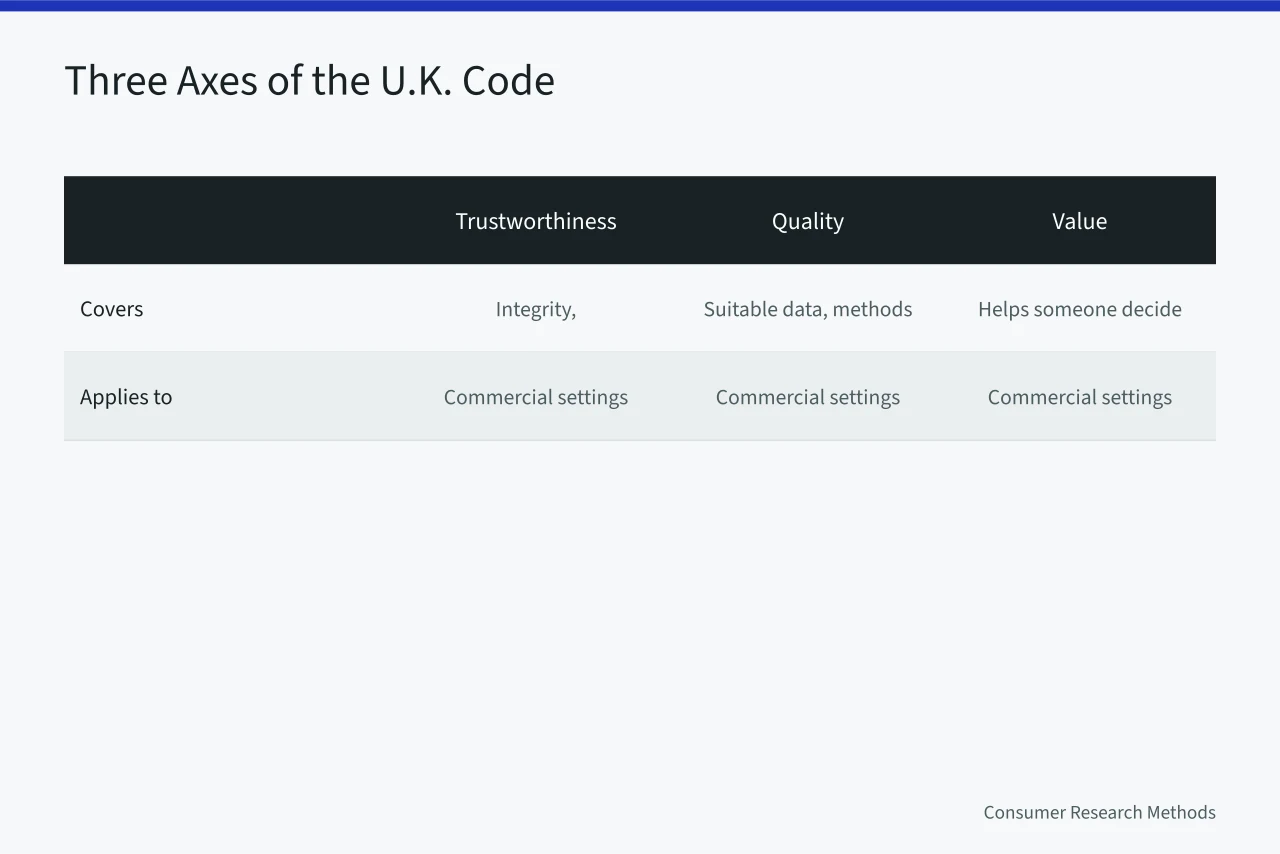
Trustworthiness covers integrity and transparency. Quality covers suitable data and methods. Value covers whether the output helps someone decide. The regulator states the principles can be used outside official statistics, including commercial settings.
Applying them does not make your study official statistics. It gives you three axes to report on instead of one.
Build the definition before the number
Most benchmark arguments are definition arguments wearing a disguise. Two teams report "completion rate" and mean different things.
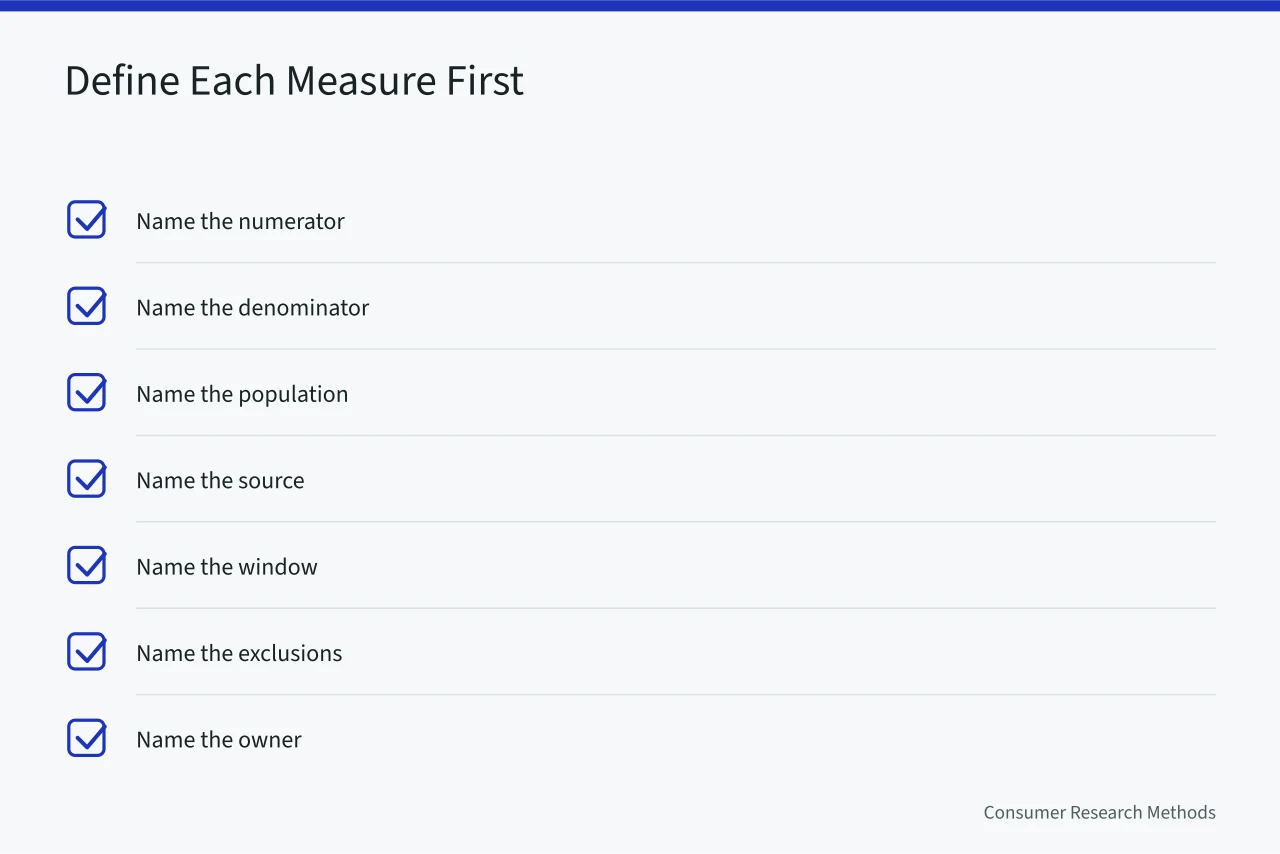
Write the definition first. Name the following:
- the numerator
- the denominator
- the population
- the source
- the window
- the exclusions
- the owner Add the uncertainty and the threshold that triggers action.
Do this once per measure, in writing, and the argument mostly disappears.
Where benchmarks quietly break
Four failure modes show up again and again in small-team research.
- Narrowed denominator. A team drops canceled studies from the base and the rate improves. The work did not.
- Reclassified incidents. An unresolved complaint becomes a "process note" and leaves the count.
- Borrowed thresholds. A target from another industry, market or method gets applied as if it were local.
- Averages over distributions. One bad study vanishes inside a mean that looks healthy.
Each one makes the number better without making the research better. Catching them early is the whole point of spotting market research strategy mistakes before they cost money.
A worked example of a benchmark card
Take decision coverage, the share of commissioned studies that had a named decision, owner and deadline before fieldwork started.
| Field | Entry |
|---|---|
| Measure | Decision coverage |
| Numerator | Studies with a named decision, owner and deadline at kickoff |
| Denominator | All commissioned studies in the period |
| Source | Project intake records |
| Window | Rolling four quarters |
| Exclusions | Studies cancelled before kickoff, with reason logged |
| Owner | Research lead |
| Threshold | Below 80 percent triggers an intake review |
| Review date | Quarterly |
The threshold is local. It reflects how much a missed decision costs this team, not an industry figure.
Design choice is not effect estimation
The GAO evaluation design guide connects evaluation questions to evidence needs and design choices. The NIST experimental design guidance starts design selection with the objective and the practical constraints.
Both point the same way. A benchmark that reports how the research system performs is not a controlled effect estimate. Keep the two apart, or a marketing result starts reading as causal. When the numbers do need interpreting, a working brief on market research analysis sets out how to read them without overclaiming.
Keep the comparison honest
Report the distribution, not only the mean. Report the count of failed studies next to the count of successful ones.
Record who owns each measure and who reviews it. If a step is automated, name the human who checks it.
Then revisit the whole set when decisions, markets, methods, populations or suppliers change. A benchmark that outlives its decision is just a number.
Common questions
What makes a market research benchmark defensible?
An exact definition, a stated denominator, a named source and a review date. Add the owner and the threshold that triggers action. Without those, you are comparing two different measures and calling it a trend.
Should industry averages set our targets?
Usually not. Decisions, markets, methods, samples, fieldwork and definitions differ enough to make the figures incomparable. Use an external figure as context, then set your threshold from your own cost of being wrong.
How often should benchmarks change?
Review them after material change: new decisions, new markets, new methods, new suppliers, new populations. A quarterly review date forces the conversation even when nothing obvious has shifted.
Do these standards apply to commercial research?
The OMB standards bind federal statistical surveys, not private studies. The U.K. code is written for official statistics, though the regulator says the principles travel. Treat both as borrowed structure, not as obligations you owe anyone.