Reviews
Part of Making sense of market research strategy (2027 update)
Market research strategy tools ranked: which ones earn a place
Market research strategy tools ranked by what they do for scoping, fieldwork, analysis and repositories, with the ones worth adopting for small teams.
What to take away
- Rank tools by the decision they serve, not by feature count. A screener log and a citation library solve different problems and do not belong on the same score sheet.
- The five worth adopting for most small teams are Qualtrics, Prolific, Dovetail, Airtable and Zotero, each for a different stage of the study.
- Free tiers cover discovery, screening logs and repositories. Paid tiers start where sample, coding volume or governance starts to hurt.
- Price scales with completes, seats, records or storage. Get the unit in writing before you commit.
- Every tool needs an exit test: export the full dataset, delete the account, confirm deletion in writing.
Ranking market research strategy tools is easy to get wrong because the category is not one category. A survey platform, a participant panel and a coding workspace do different jobs. Score them on the same sheet and the survey platform wins on features it will never use.
The ranking below sorts tools by the decision each one unblocks. It favors small teams and independent practitioners who need evidence they can defend, not the widest feature list. Google Forms and the SurveyMonkey free tier handle simple questionnaires, but they cap questions and responses and keep no audit trail, so neither earns a place here.
How the ranking works
Three criteria, in order.
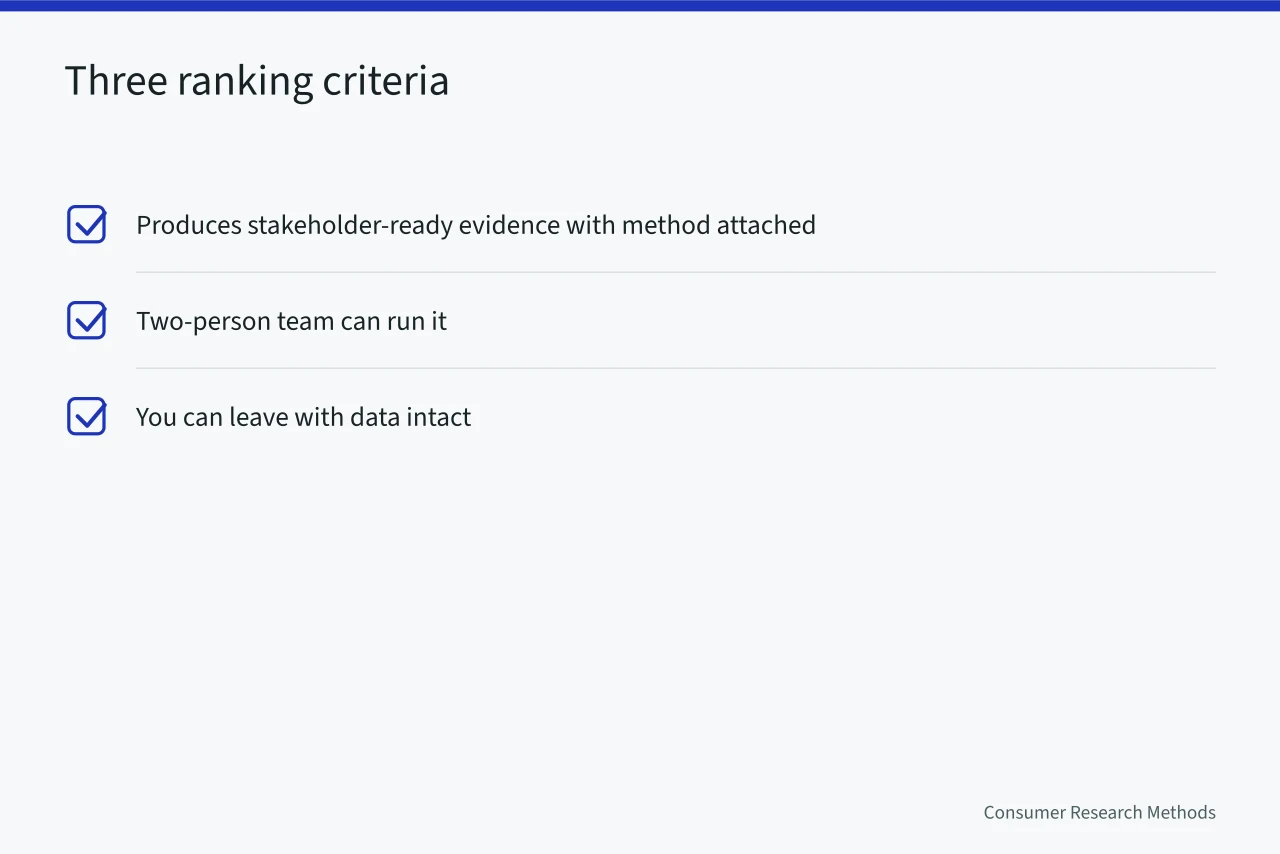
A tool that fails the third criterion is a rental, not a purchase. That is the test a market research strategy should apply before any contract is signed.
The tools, ranked
1. Qualtrics
Survey platform. Question types, randomization, quotas, weighting and audit logs sit in one system, which matters when a tracker repeats every quarter. It suits teams running recurring quantitative work who need reproducibility.
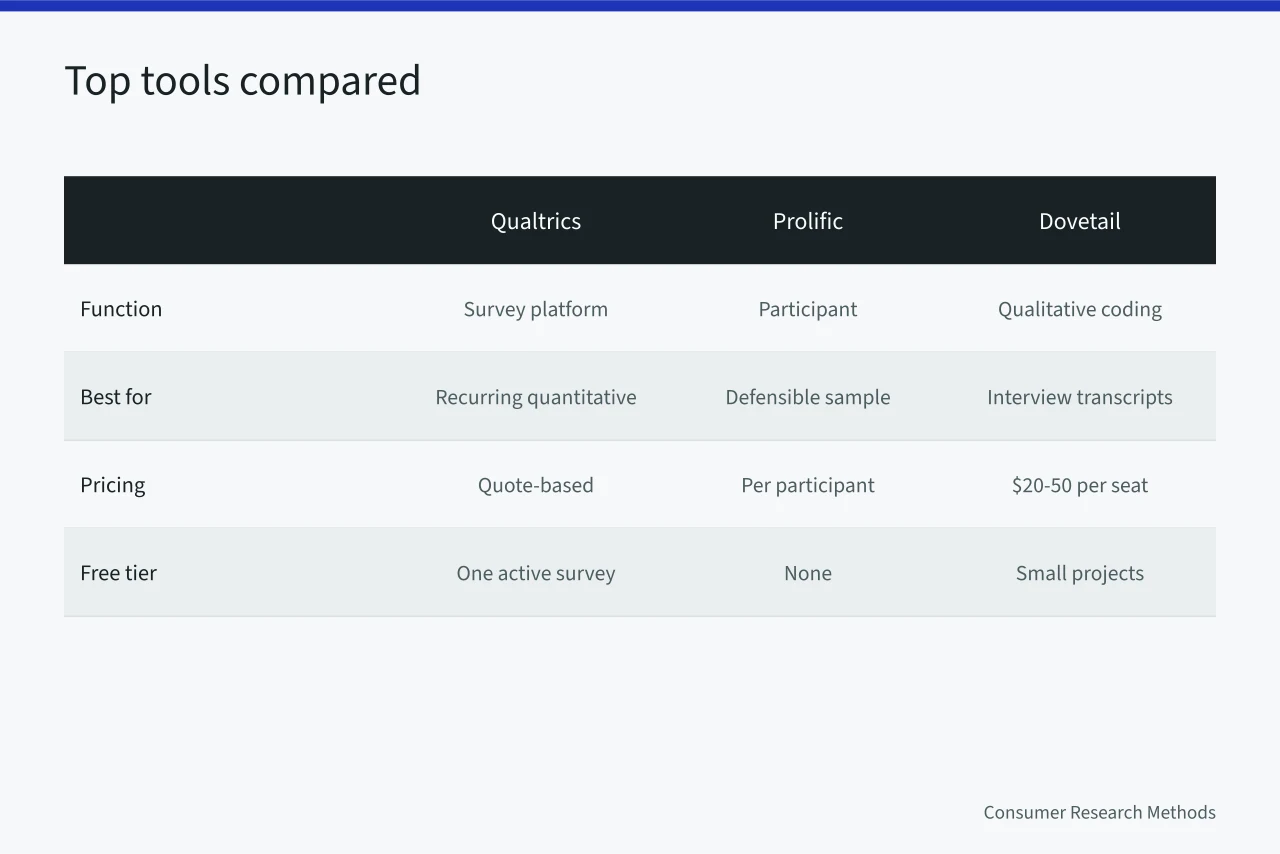
The free account allows one active survey, and paid pricing is quote-based, so ask for the per-response and per-seat units in writing. Best routing logic on the list, weakest cost transparency.
2. Prolific
Participant recruitment. It screens on demographics and prior-study history, which reduces the professional-respondent problem that plagues open panels. Academic and applied researchers who need a defensible sample frame get the most from it.
You pay per participant plus a platform fee, and Prolific publishes minimum hourly pay rates for participants. Cheaper than agency recruitment, narrower than a full-service panel.
3. Dovetail
Qualitative coding and synthesis. Transcription, tagging, clip extraction and a searchable repository sit in one workspace. It suits teams drowning in interview transcripts.
Per-seat pricing with a free tier for small projects; paid seats typically run from about $20 to $50 per user per month, depending on tier and billing term. The tagging model is the reason to choose it; the export is the reason to check before you commit.
4. Airtable
Screener tracking, recruitment logs and study operations. Not a research tool by design, which is exactly why it works: flexible enough to hold quotas, consent status and incentive payments in one view. Teams that need a system of record before they need a research platform fit it best.
The free tier caps a base at 1,000 records, and paid Team seats typically run about $20 per user per month billed annually. Check the attachment limit before you store recordings there.
5. Zotero
Source and citation management for secondary research. Free and open source, with paid storage: 2GB free, 6GB for about $20 a year, unlimited for about $120 a year. It suits anyone building on U.S. Census Bureau, BLS or published industry data, where the source, access date and revision history matter as much as the number.
Where the free tier stops
Free tiers cover discovery and repositories well. They stop at sample, coding volume and governance.
Qualtrics free caps active surveys. Dovetail free caps project size. Prolific has no free tier. Airtable free caps records at 1,000 per base. Zotero is free at every tier, which is why it stays on the list.
Budget the paid tier from the unit that scales, not the headline price. If a study needs N completes at a per-complete rate, the arithmetic is N times rate, plus platform fees. Substitute your own figures; rates vary by market and vendor.
Pilot before you buy
Run one bounded study through the full path:
- screener
- consent
- collection
- coding
- export
- deletion Include a withdrawal and a corrected finding.
The NIST Privacy Framework is a voluntary risk-management tool, not a certification. Use it to ask who controls the data, who has access, and how deletion is verified.
The GOV.UK technology selection guidance recommends adaptable choices and ownership-cost analysis. Apply those questions to research tools; they are not endorsements.
The GOV.UK open standards guidance links open standards with reduced supplier dependence. Test whether your data and definitions move. A market research strategy checklist turns that into concrete decisions about evidence, questions and methods.
Digital.gov's research planning guide covers consent, interview planning and participant experience in a U.S. federal context. It does not rank software. Convert its steps into tool requirements.
Worked example: a five-interview study
A two-person team needs five interviews with operations managers at mid-size logistics firms.
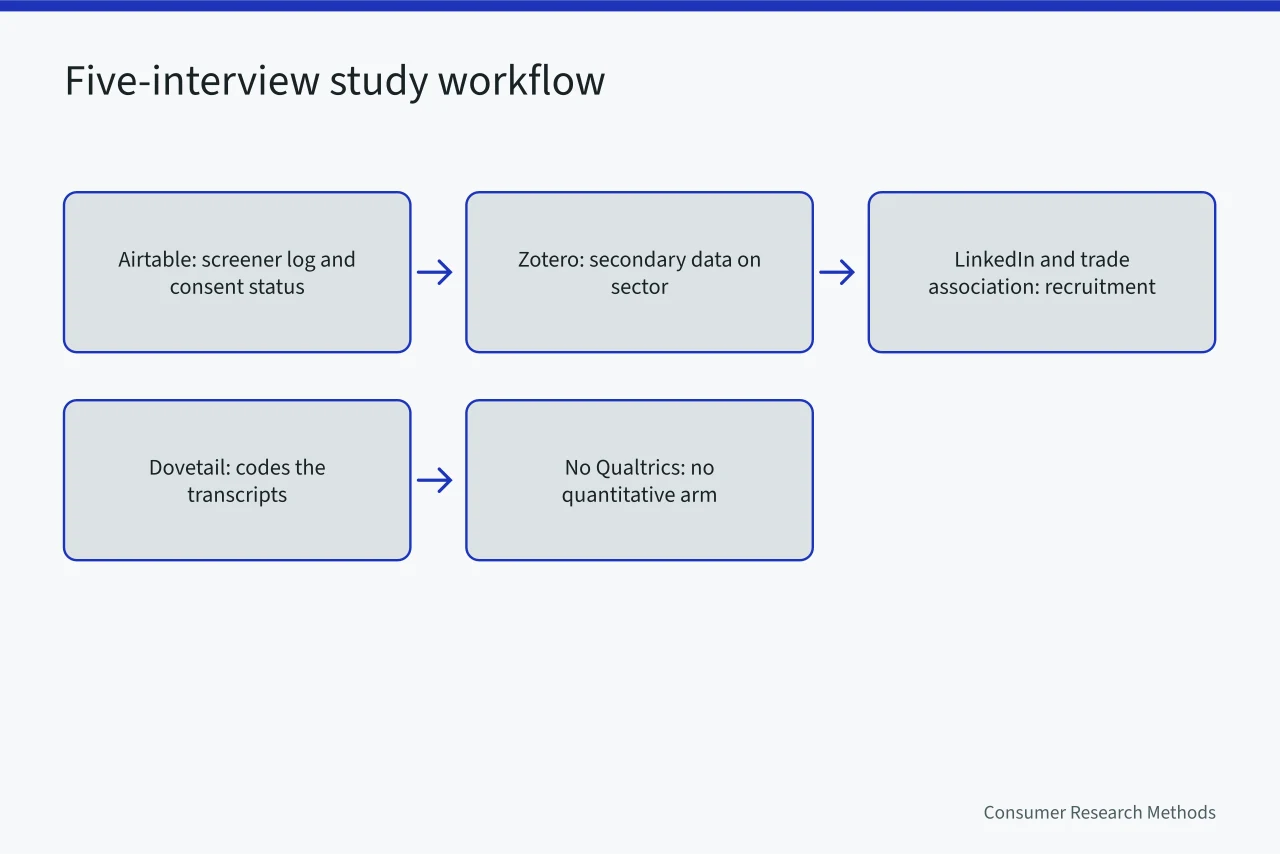
Airtable holds the screener log and consent status. Zotero holds the secondary data on the sector. Prolific is not used; recruitment runs through LinkedIn and a trade association list. Dovetail codes the transcripts. Qualtrics is not used; there is no quantitative arm.
Total tool cost: Airtable free tier, Zotero free, Dovetail paid tier for one month. The expensive part is recruitment time, not software.
Common questions
How many tools does a small team need?
Three or four, covering recruitment, collection, coding and a system of record. Add a fifth only when a specific decision cannot be made without it. A market research analysis plan should name which tool holds which artifact before collection starts.
What matters more than a feature list?
Task completion on a real study, consent handling, export completeness and exit cost. A tool that scores well on features but cannot export your raw data is a liability. Common market research strategy mistakes start with buying on the demo, not the pilot.
Do free tiers hold up?
For discovery, screening logs and citation management, yes. For sample, coding volume and governance, no. Plan the upgrade trigger before you start, not after you hit the cap.
What belongs in a pilot?
One bounded study with a withdrawal, an access change and a corrected finding. Score task completion, participant safety, effort, support, total cost and verified deletion. Buy only after the exit test passes.