Operations
Part of Primary market research: the version that survives contact with reality
What primary market research asks, and why
Common primary market research questions for 2027 cover method choice, sample limits, consent, incentives, agency use, and responsible follow-up.
What to take away
- Method and sample questions have no responsible answer until the decision is fixed.
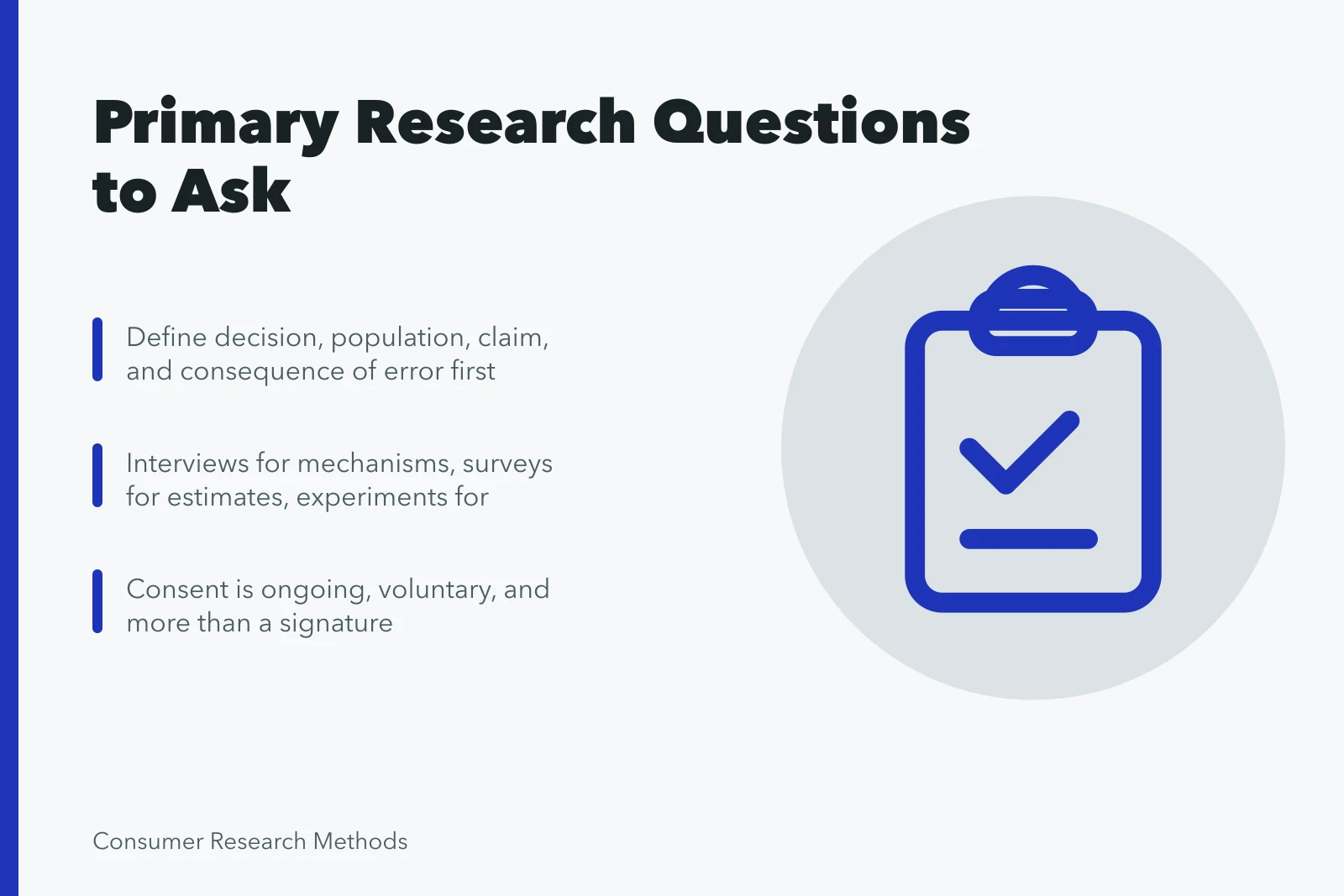
- Consent is an understandable, voluntary process that continues through participation rather than a signature collected at the start.
- Recruitment, incentives, accessibility, agency use, and later contact need explicit purposes, safeguards, owners, and review.
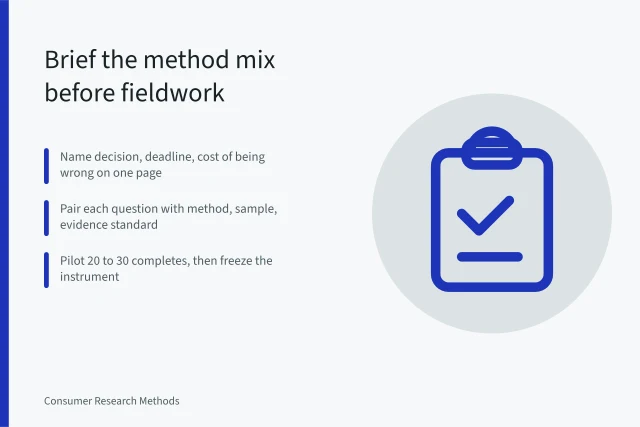
- Fix a threshold, an owner, and a date in a written decision record.
Common primary market research questions usually begin with methods and sample size. Better answers begin with the decision, population, claim, participant risk, existing evidence, and consequence of error. No single method or participant count is right for every business question.
Who counts as a customer
Write the list as roles, not as the people who already use the product. Include users, buyers, approvers, payers, former customers, and people the current system excludes. Name the groups the study cannot represent.
When is primary research necessary?
Use it when a consequential evidence gap remains after reviewing internal records, prior studies, official statistics, credible publications, and lawful market evidence. Existing sources and direct research are complementary when each resolves a different part of the decision.
Which method should a team choose?
Choose interviews or observation for mechanisms and context, surveys for defined estimates, experiments for specified effects, and usability or product tests for interaction with a design. Combine methods only when each resolves a distinct uncertainty. Interviews describe a process, surveys estimate a quantity, experiments test effects, and conjoint surveys estimate preference at group level.
Match Method to Evidence Need
Method
- Interviews or observation
- Mechanisms and context
- Surveys
- Defined estimates
- Experiments
- Specified effects
- Usability or product tests
- Interaction with a design
Best For
- Interviews or observation
- Surveys
- Experiments
- Usability or product tests
How many participants are enough?
It depends on the claim, method, population diversity, sampling frame, precision, subgroup needs, expected response, complexity, and decision risk. A large convenience sample may still be biased. A small qualitative study may discover important mechanisms but cannot estimate their prevalence.
Interview counts track variation in the population and the cost of a wrong decision, not a fixed target. Typical planning ranges for a medium-risk decision are 8 to 12 interviews per segment, and 5 to 8 where segments behave alike. Stop a segment when two interviews in a row add no new code.
For estimates, about 400 completes give plus or minus 5 percentage points at 95 percent confidence, and about 1,100 give plus or minus 3. Both are typical planning figures, not a standard.
What should participants be told?
The HHS Office for Human Research Protections' informed consent FAQ describes disclosure, understanding, and voluntariness as core features of informed consent and says a signed form alone is not the process. Its rules concern covered human-subjects research.
Explain purpose, organizer, activities, duration, data collected, recording, observers, use, sharing, retention, confidentiality limits, voluntary choice, withdrawal, rights, incentive, contacts, and complaints in accessible language. Check understanding before starting.
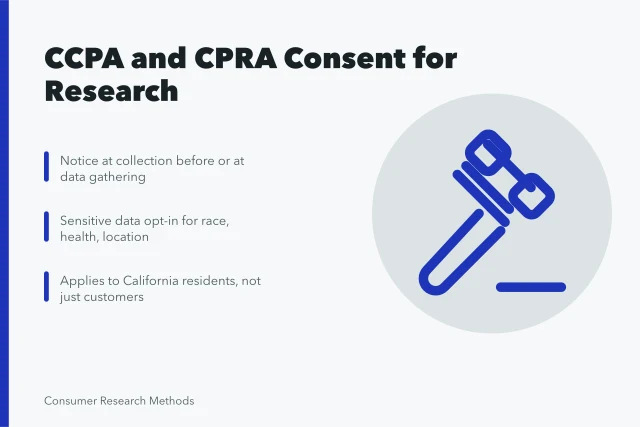
US rules come from state privacy statutes, including the California Consumer Privacy Act and the California Privacy Rights Act. Sector rules cover health data under HIPAA and financial data under the Gramm-Leach-Bliley Act. Research on human subjects that is federally funded or regulated falls under 45 CFR 46 and can require institutional review board approval.
Canadian commercial activity falls under PIPEDA, which requires meaningful consent and retention limits. The Office of the Privacy Commissioner of Canada is the regulator; UK guidance from the ICO is a comparison, not the governing baseline.
Can research leads receive sales follow-up?
Do not hide promotion or list building inside research. Research and promotional follow-up can have different obligations. Obtain current jurisdiction-specific advice, state each purpose honestly, and keep people, scripts, data, permissions, and systems separate.
The FTC Telemarketing Sales Rule, at 16 CFR Part 310, sets the questions a panel or list vendor should answer.
Should incentives be offered?
The GOV.UK Service Manual's participant recruitment guidance covers target groups, privacy, accessible recruitment, incentives, and avoiding pressure in government user research. The suggested practices and participant counts are context-specific. Define the relevant population and burden locally, then test whether the recruitment path excludes or pressures anyone.
Incentives can recognize time and expenses, improve access, and reduce participation barriers. Set them transparently and proportionately so they do not create undue pressure. Explain payment timing, partial participation, withdrawal, taxes where relevant, and supplier responsibilities.
Typical US practice pays about $50 to $150 for a 45 to 60 minute consumer interview. Executive and clinical interviews cost more. Canadian panels can price differently because consent, deletion, and audit duties differ.
When should an agency be used?
External help can add specialist methods, recruitment access, independence, language, or capacity. Review the actual team, sample sources, subcontractors, participant care, quality controls, analysis, data rights, security, incidents, corrections, pricing, and references. The business must still own the decision.
A useful answer always states what the evidence can and cannot support. Preserve negative and inconclusive results, show sampling and measurement limits, and record how the decision changed. Professional codes offer a baseline, but sector, country, and organizational requirements may add stricter duties.
Recording those limits also feeds the decision coverage and evidence reuse measures in market research strategy benchmarks.
Primary research question triage
Define first
- How many?
- Population, design, precision
- Which method?
- Evidence gap and claim
- What incentive?
- Burden, access, pressure
- Which agency?
- Decision, team, safeguards
Do not assume
- How many?
- Large means representative
- Which method?
- Survey is the default
- What incentive?
- Higher is always better
- Which agency?
- Brand proves fit
Resolve the question with a decision record
The GAO evaluation design guide connects evaluation questions with evidence needs and design choices.
The W3C Privacy Principles statement gives web-system designers shared privacy concepts and warns against shifting privacy work to individuals.
Set three entries before fieldwork: threshold, owner, date. In one example, a checkout test counts as a win at a lift of 3 percentage points, the research lead signs the read-out, and the decision meeting is booked first.
Common questions
How many interviews are enough?
There is no universal count. Scope, population diversity, complexity, decision risk, and the type of claim determine the design.
Can customers join research voluntarily?
Yes, when the invitation, choice, withdrawal, data use, and service consequences are understandable and genuinely voluntary.
Can research responses become sales leads?
Do not make that use silently. Separate purposes and systems and obtain the permissions and qualified review required for the market.