Reviews
Part of Primary market research: the version that survives contact with reality
Primary market research mistakes: the traps and the way around them
Primary market research mistakes start with a favorite method, re-asking known questions, easy samples and cleaning that hides inconvenient answers.
What to take away
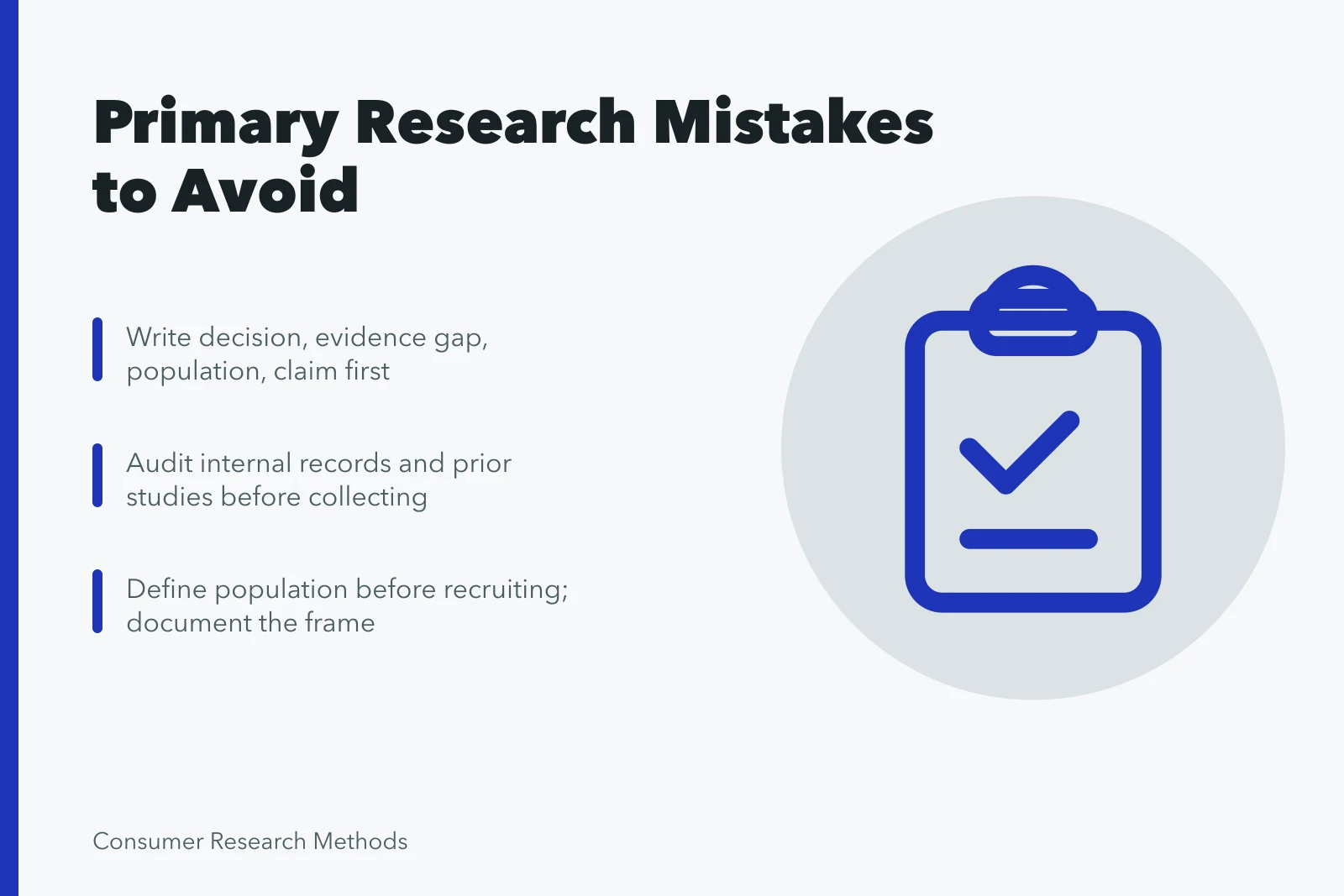
- Write the decision, the evidence gap, the population and the claim before you pick a method. The method is the last choice, not the first.
- Check internal records, prior studies and federal data before you put a question to a participant. Burden without a gap is waste.
- A signed form does not prove understanding. Reconfirm consent when the activity, the recording or the audience changes.
- Predefine quality checks and keep the raw file. An answer you dislike is data, not a defect.
- A vivid quote shows one experience. Only a sample with a known frame shows how common it is.
Primary market research fails in the design, not in the report. A polished deck cannot repair a vague decision, a narrow frame or a claim the evidence never supported. The patterns below are the ones that recur, and each comes with the correction.
Starting with a favorite method
A team runs a survey because the team runs surveys. The instrument arrives before anyone can say what decision it serves.
Decide Before You Choose a Method
- Write the decision first
- Name the evidence gap
- Define the population
- State the claim
- Then select method
Write four things first: the decision, the evidence gap, the population, and the claim you hope to make. Then choose. Interviews suit mechanism and language. Observation suits behavior people cannot recall. A survey suits prevalence. An experiment suits causation. The primary market research examples show how the choice changes once the decision is fixed.
Researching what is already known
Participants carry a cost when the answer already sits in a file. Audit internal records, prior studies and public data before you recruit anyone.
The U.S. Census Bureau's survey methods research program works on questionnaire wording, respondent comprehension, multilingual design and pretesting. Read it as a set of categories for testing your own instrument, not as a seal of approval on a commercial study.
Collect new data only for a material gap. Then ask whether the older evidence still fits the population and the decision in front of you.
Recruiting only easy supporters
Current enthusiasts are the cheapest people to reach and the worst people to ask about barriers. Leavers, non-users and people who were turned away hold the answers you need.
Define the population before recruiting. Document the frame and the exclusions. Where coverage stays incomplete, narrow the claim rather than widening the sample.
Leading participants
Praise, internal jargon, assumed benefits and a visible executive preference all shape answers. So does a question that names the answer inside it.
Use neutral wording and balanced options. Ask broad questions before probes. Blind concepts where you can. Test the instrument with people who match the real population, and hunt for the case that contradicts your hypothesis.
Treating consent as paperwork
The HHS Office for Human Research Protections publishes an investigator responsibilities FAQ covering consent, records and reporting duties under HHS rules. Its legal reach is narrow. The operational lesson travels: name one accountable owner, and keep the approvals, deviations and corrections on file.
A signature proves a pen moved. It does not prove the person understood the purpose, the recording, or who will see the data. Reconfirm when any of that changes.
Mixing research with sales
A research invitation that ends in a pitch burns the panel and may change your legal obligations. Keep purpose, team, script and follow-up separate, and never bury lead generation inside a study.
Overcleaning inconvenient data
Fraud and straight-lining need investigation. An answer you did not want does not.
Predefine the quality signals and the exclusion rules. Use more than one check. Keep the raw file. Report how many cases you removed, and test whether the conclusion survives when you put them back.
Turning quotes into prevalence
One vivid quote illustrates one experience. It cannot tell you how many people share it. Report qualitative findings as mechanisms with context, and survey findings with the sample and the uncertainty attached. Teams that need prevalence should move to quantitative research with a defined frame.
When a mistake touches participant rights, data integrity or a live decision, pause the study. Preserve the evidence, correct or withdraw the output, and document why you restarted.
Mistake correction card
| Mistake | Evidence risk | Correction |
|---|---|---|
| Easy sample | Coverage bias | Define frame and exclusions before recruiting |
| Selective cleaning | Outcome bias | Predefine checks, keep raw data, run sensitivity |
| Favorite method | Design bias | Fix the decision and the claim first |
| Hidden sales use | Participant and legal risk | Separate purpose, team and script |
Prove the correction
The GAO data reliability guide treats reliability as fitness for an intended use and asks for a documented assessment. Apply that test to your own study. The guide does not certify your data.
The FTC advertising substantiation policy requires a reasonable basis before an objective advertising claim goes out. Whether your evidence clears that bar depends on the facts, so take advice on the actual claim.
Common questions
Can a large sample fix biased recruitment?
No. Sample size shrinks sampling variability, but it cannot bring back the people your frame or your recruitment method systematically missed. A bigger biased sample is a more precise biased estimate.
Is a signed consent form enough?
No. The purpose, the activity, the data use and the right to withdraw have to be understandable at the moment of participation, not just at signature. If the recording, the observers or the audience change, ask again.
When should data be excluded?
Only under rules you wrote before fieldwork, based on evidence rather than on whether you liked the answer. Keep the original records, log every exclusion, and check whether the conclusion moves when the excluded cases return.
Do the Census Bureau and GAO sources apply to a small commercial study?
They are federal methods and audit standards, not regulations that bind a private study. Use them as checklists for wording, pretesting and reliability, and keep your own documentation. For common primary market research questions, the same discipline applies at any budget.